

The astronomy collection consists of around 300 artifacts, most of which were used for teaching and research at the University of Toronto Department of Astronomy & Astrophysics and the department’s main observatory, the David Dunlap Observatory (DDO). The department, initially known as the Department of Astrophysics and later as the Department of Astronomy, was founded as a department under Professor Clarence Augustus Chant in 1905. The Observatory, which boasted the second largest optical telescope in the world at its establishment, opened in Richmond Hill, Ontario in 1935, and was the Department’s home throughout much of the 20th century. When the observatory closed and the property sold by the university in 2009, equipment and artifacts remaining there were moved to storage at the Department of Astronomy & Astrophysics at the downtown Toronto St George campus.
The observatory is now a National Heritage Site. It is owned by the City of Richmond Hill and operated by the city with community partners offering interpretation and educational programming, including the Royal Astronomical Society of Canada – Toronto Centre.
Objects in the Department of Astronomy & Astrophysics’ historical collection range from a collection of celestial globes used to teach undergraduate students to a small selection of 18th century antiques, including a number of pocket sundials, to artifacts associated closely with the David Dunlap Observatory, including both scientific apparatus and decorative components. The collection also includes the lens of the “Einstein Camera” designed by U of T engineer C.R. Young and used by C.A. Chant and R.K. Young during the effort to test Einstein’s General Theory of Relativity during the September 21, 1922 solar eclipse observed in Australia.
Other collections of interest include astronomical equipment used during WWII for training pilots and others in astronomical navigation techniques, and some memorabilia and instruments connected with Toronto astronomers and their families, including a light table which was used by U of T astronomers Helen Sawyer Hogg and Christine Clement in research on variable stars.
At the close of the David Dunlap Observatory in 2009, a number of items, including many locally-constructed instruments, were acquired from the Observatory by the Canadian Science and Technology Museum in Ottawa, now part of Ingenium. These objects can be found in Ingenium’s catalogue here.
In 2009, the collection was assembled and then overseen by Lee Robbins, then Head Librarian at the Astronomy & Astrophysics Library, David A. Dunlap Department of Astronomy and Astrophysics.
Seeing the Collection
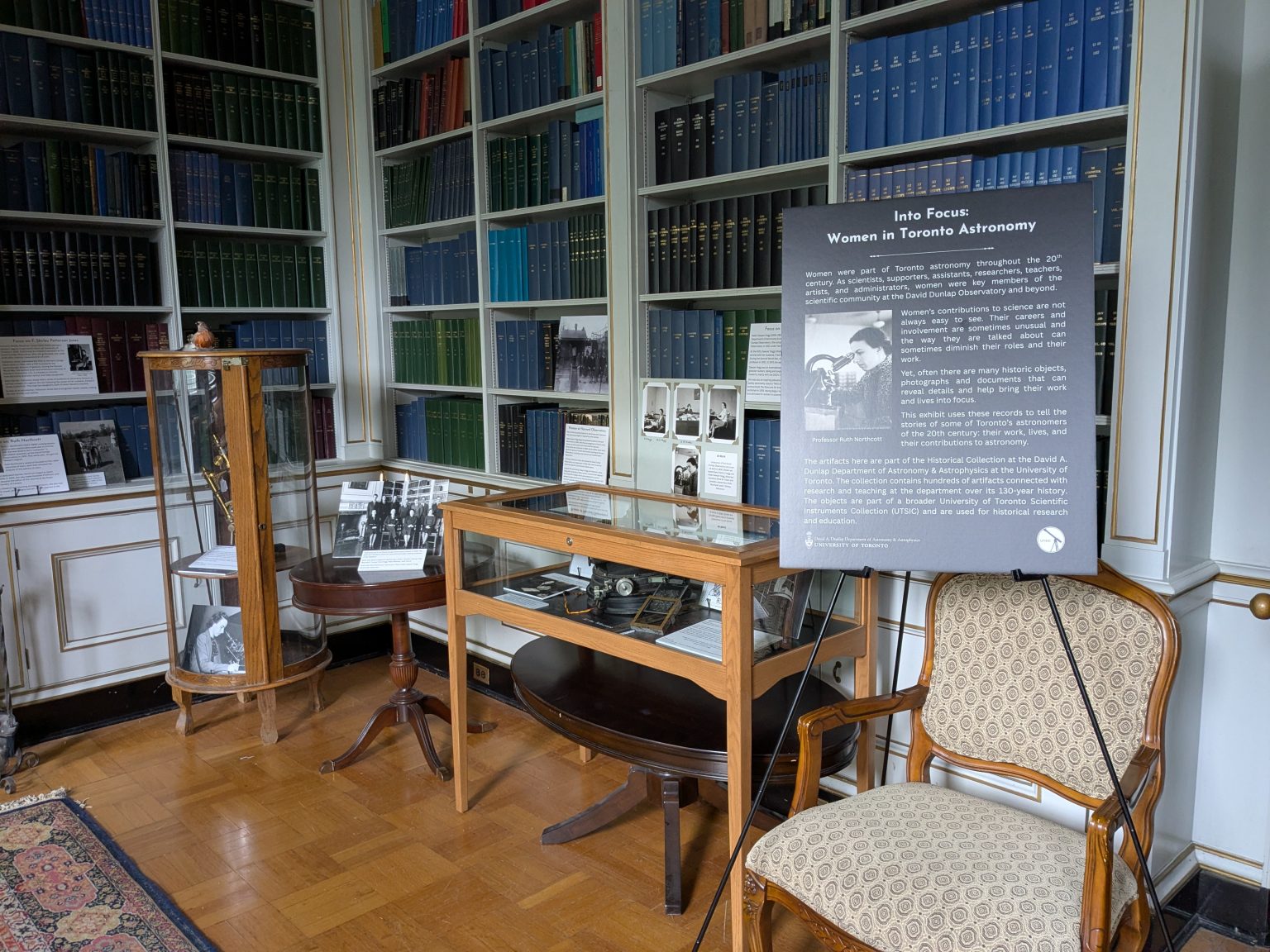
Until October 2026, an exhibit featuring artifacts from the Astronomy collection that give insight into the lives and work of women in Toronto astronomy, alongside archival images, is on display at the Richmond Hill David Dunlap Observatory. Into Focus: Women of Toronto Astronomy can be found in the observatory’s beautiful 1930s library. Visit during “Tour the DDO” open times from June to October. This is a free program! Learn more here.
A display case featuring items related to prominent astronomer and authority on variable stars, Helen Sawyer Hogg, is on show at the David A. Dunlap Department of Astronomy & Astrophysics building, on the University of Toronto’s St George Campus (50 St. George Street). The building is generally open to the public 9am-5pm, and the display can be found on the second floor of the building. Accessing the exhibit requires climbing a flight of stairs.
Access: Most of the collection is not open to the public. Interested researchers should apply to Victoria Fisher, Historian in Residence, David A. Dunlap Department of Astronomy & Astrophysics.